Linear equations with the unknown in the denominator: worked examples
A linear equation with the unknown in the denominator is an equation in which the unknown appears below the fraction bar, for example . It is solved by writing the conditions first (a denominator cannot be zero) and multiplying by the common denominator; the result is then checked against the conditions. Find out more
Every example on linear equations can be solved right on the Learniva board, just like on paper. Learniva checks your whole working and shows you where the mistake is and why.
Solve on the board60 examples with the unknown in the denominator: solutions and worked steps
Příklady 1–16
-
-
-
-
-
- Condition:
- Cross-multiply:
- The numbers whose square is 36 are 6 and −6.
Result: or
Solve on the board -
-
-
-
-
- Conditions: and
- Multiply by (x − 2)(x + 2), then combine.
- After simplifying: (contradiction)
Result: solution)
Solve on the board -
-
-
-
- The denominator x² − 9 equals (x − 3)(x + 3).
- Conditions: and
- After simplifying you get 2x = 2x.
- It holds for every number except the excluded values.
Result:
Solve on the board -
-
Equations with the unknown in the denominator – examples as a PDF worksheet, free to download
Download the examples from this page as a worksheet in PDF. Just enter your e-mail.
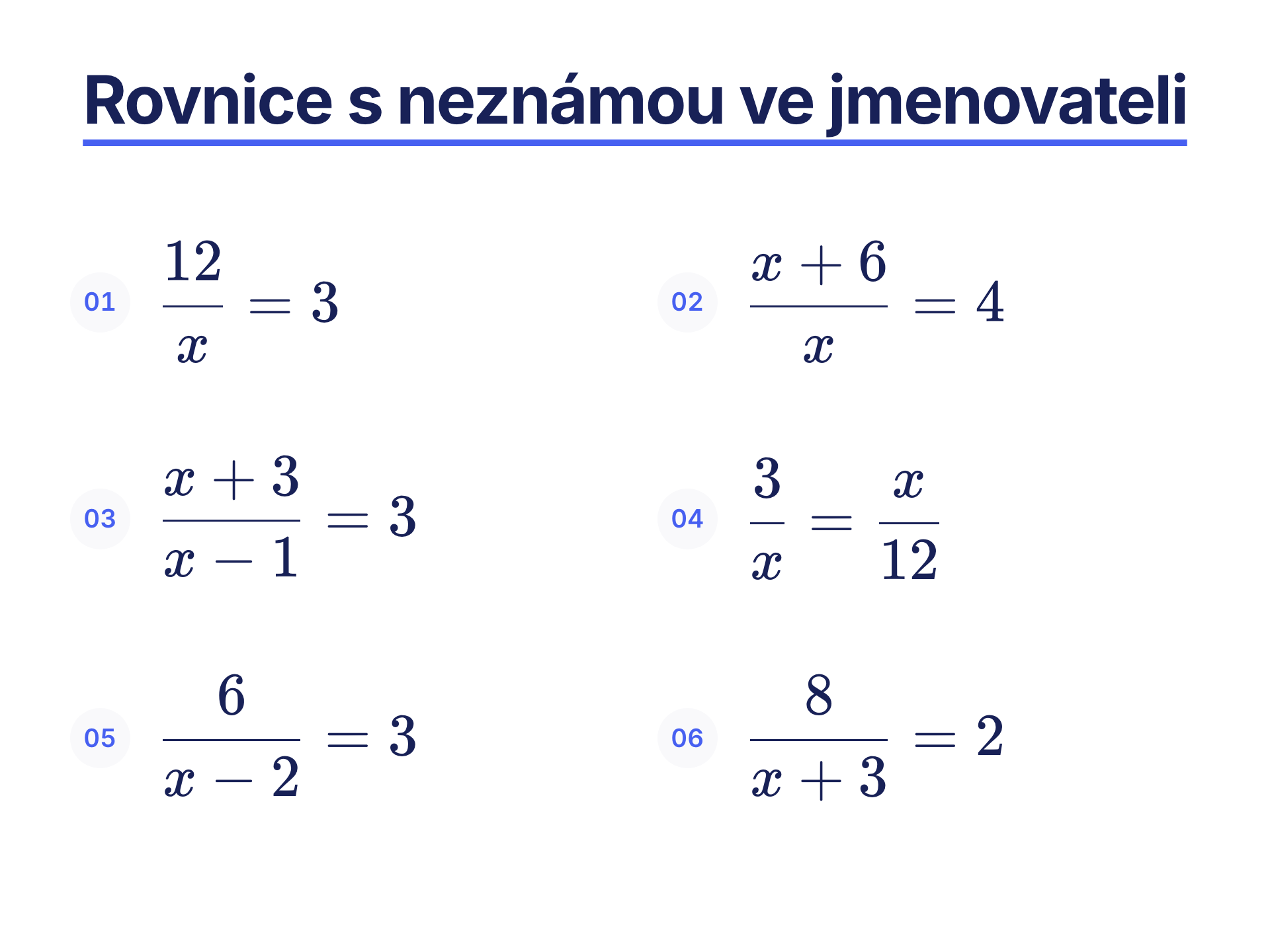
How to solve examples with the unknown in the denominator: a step-by-step guide
Conditions, multiplying by the denominator and two worked examples, including one with no solution
What is an equation with the unknown in the denominator?
After multiplying by the denominator, the equation becomes an ordinary linear equation. There is one extra step: you cannot divide by zero, so a value of x that makes any denominator zero cannot be a solution.
Rule: no dividing by zero. Write the conditions at the very start, before the first step. At the end, compare them with the result: a value that breaks a condition is not a solution.
How to handle examples with the unknown in the denominator
If the unknown is in a denominator, that denominator must not be zero. So before any rearranging, write down the conditions: for they are and . Then multiply by the denominators (or cross-multiply), clear the fractions and continue as with an ordinary linear equation.
Step by step
- Write the conditions
Set every denominator containing x different from zero and solve. These values of x are not allowed.
- Multiply by the denominators
Multiply the whole equation by the common denominator; with two fractions, cross-multiplying is enough.
- Solve the linear equation
Expand, move the x terms to one side and divide.
- Compare with the conditions
Cross out any result that breaks a condition. Check the remaining ones by substitution.
At the end, compare the result with the conditions. If a forbidden value comes out, the equation has no solution even though the calculation looked fine. The opposite can happen too: after simplifying you get , and then every number except the forbidden ones is a solution.
Worked example 1: the unknown in two denominators
- the equation
- conditions
- multiply by both denominators
- expand
- subtract 3x and 5
- divide by 2, meets the conditions
Worked example 2: an equation with no solution
- the equation
- condition
- multiply both sides by x − 2
- The only result breaks the condition, so the equation has no solution.
Do the check in the original equation with fractions. For x = −4 the left side is 5/(−5) = −1 and the right side is 3/(−3) = −1. Substituting into the equation without fractions is not enough, because it cannot spot a forbidden value.
Common mistakes in examples with the unknown in the denominator
-
Missing conditions
What it looks like. You solve without the condition . Here you get away with it, but in another equation exactly the forbidden value comes out and you hand it in as a solution.
How to avoid it. Write the conditions as the very first step, before any rearranging. Teachers and entrance exams expect to see them.
-
Multiplying only one term
What it looks like. In you multiply only the fractions by x: .
How to avoid it. The 3 gets multiplied too: , so .
-
A difference of squares in the denominator
What it looks like. With you look for a common denominator with the fractions over and and multiply by everything at once.
How to avoid it. , so this product already is the common denominator. The conditions are and .
FAQ on examples with the unknown in the denominator
Why do we write conditions for these equations?
Because you cannot divide by zero. Values of x that make a denominator zero cannot be solutions, and without the conditions you would never notice.
What if the result breaks a condition?
Then the equation has no solution (or only the results that satisfy the conditions remain). The calculation was not wrong; that value simply is not allowed.
Is an equation with x in the denominator still linear?
Not in its fractional form, but after multiplying by the denominator it usually becomes a linear equation. Sometimes a quadratic appears, as in , which gives .
How do I check the result?
Substitute the result into the original equation with fractions and evaluate both sides. Also make sure no denominator became zero.
How does practising on the board work?
Equations with the unknown in the denominator can be practised right on Learniva’s interactive board. You write your own working step by step, by hand as on paper or on the keyboard, and Learniva checks every step. If you make a mistake, it marks the step where it happened and tells you what is wrong with it, for example that the step changed the solution of the equation. You can try it for free with any example using the Solve on the board button.
Which school year are these examples for?
The examples on this page are meant for 9th grade.


Equations with the unknown in the denominator follow the Czech RVP ZV, the framework curriculum for basic education issued by the Ministry of Education (MŠMT). Their difficulty matches established Czech lower-secondary problem collections such as F. Běloun’s.
Page created on .