Linear equations: word problems with solutions
A word problem with a linear equation is a problem given as text from which an equation is built, for example “two numbers add up to 30 and one is 6 greater” gives . It is solved in four steps: choosing the unknown, building the equation, solving it and writing the answer as a full sentence. Find out more
Every example on linear equations can be solved right on the Learniva board, just like on paper. Learniva checks your whole working and shows you where the mistake is and why.
Solve on the board60 word problem examples with equations: solutions and worked steps
Příklady 1–16
-
-
-
-
- The numbers are x, x + 1, x + 2.
- Set up the equation:
- Simplify:
- Solve:
Result: The numbers are , and .
Solve on the board -
- Jana = x, Petr = x + 80.
- Set up the equation:
- Simplify:
- Solve:
- Petr has 160 + 80.
Result: Petr has Kč and Jana has Kč.
Solve on the board -
- Son = x, father = 4x.
- Set up the equation:
- Simplify:
- Solve:
- Father = 4 × 12.
Result: The father is years old and the son is .
Solve on the board -
- Width = x, length = x + 6. Perimeter = 2(width + length).
- Set up the equation:
- Expand:
- Solve:
- Length = 10 + 6.
Result: The rectangle is cm long and cm wide.
Solve on the board -
-
- 25 % = 0.25.
- Set up the equation:
- Or: one quarter of the number is 30:
Result: The number is .
Solve on the board -
- Boys = x, girls = x + 6.
- Set up the equation:
- Simplify:
- Solve:
- Girls = 11 + 6.
Result: There are girls and boys in the class.
Solve on the board -
-
- First = x, second = x + 12.
- Set up the equation:
- Simplify:
- Solve:
Result: The numbers are and .
Solve on the board -
-
-
-
Příklady 17–32
-
-
-
-
- The numbers are x and x + 1.
- Set up the equation:
- Simplify:
- Solve:
Result: The numbers are and .
Solve on the board -
- The numbers are x, x + 1, x + 2.
- Set up the equation:
- Simplify:
- Solve:
Result: The numbers are , and .
Solve on the board -
- Grandson = x, grandfather = 5x.
- Set up the equation:
- Simplify:
- Solve:
- Grandfather = 5 × 12.
Result: The grandfather is years old and the grandson is .
Solve on the board -
- Width = x, length = x + 7. Perimeter = 2(width + length).
- Set up the equation:
- Expand:
- Solve:
- Length = 5 + 7.
Result: The rectangle is cm long and cm wide.
Solve on the board -
- Boys = x, girls = x + 1.
- Set up the equation:
- Simplify:
- Solve:
- Girls = 8 + 1.
Result: There are girls and boys in the class.
Solve on the board -
-
- Tomáš = x, Lucie = x + 120.
- Set up the equation:
- Simplify:
- Solve:
- Lucie has 260 + 120.
Result: Lucie has Kč and Tomáš has Kč.
Solve on the board -
-
- First = x, second = x + 20.
- Set up the equation:
- Simplify:
- Solve:
Result: The numbers are and .
Solve on the board -
-
-
-
Příklady 33–46
-
-
- The numbers are x and x + 1.
- Set up the equation:
- Simplify:
- Solve:
Result: The numbers are and .
Solve on the board -
- The numbers are x, x + 1, x + 2.
- Set up the equation:
- Simplify:
- Solve:
Result: The numbers are , and .
Solve on the board -
- Son = x, father = 3x.
- Set up the equation:
- Simplify:
- Solve:
- Father = 3 × 9.
Result: The father is years old and the son is .
Solve on the board -
- Width = x, length = x + 3. Perimeter = 2(width + length).
- Set up the equation:
- Expand:
- Solve:
- Length = 15 + 3.
Result: The rectangle is cm long and cm wide.
Solve on the board -
- Boys = x, girls = x + 2.
- Set up the equation:
- Simplify:
- Solve:
- Girls = 11 + 2.
Result: There are girls and boys in the class.
Solve on the board -
-
- Jana = x, Petr = x + 40.
- Set up the equation:
- Simplify:
- Solve:
- Petr has 120 + 40.
Result: Petr has Kč and Jana has Kč.
Solve on the board -
-
- First = x, second = x + 18.
- Set up the equation:
- Simplify:
- Solve:
Result: The numbers are and .
Solve on the board -
-
-
-
Příklady 47–60
-
-
- The numbers are x and x + 1.
- Set up the equation:
- Simplify:
- Solve:
Result: The numbers are and .
Solve on the board -
- The numbers are x, x + 1, x + 2, x + 3.
- Set up the equation:
- Simplify:
- Solve:
Result: The numbers are , , and .
Solve on the board -
- Width = x, length = x + 9. Perimeter = 2(width + length).
- Set up the equation:
- Expand:
- Solve:
- Length = 12 + 9.
Result: The rectangle is cm long and cm wide.
Solve on the board -
- Boys = x, girls = x + 1.
- Set up the equation:
- Simplify:
- Solve:
- Girls = 15 + 1.
Result: There are girls and boys in the class.
Solve on the board -
-
- Jana = x, Petr = x + 90.
- Set up the equation:
- Simplify:
- Solve:
- Petr has 80 + 90.
Result: Petr has Kč and Jana has Kč.
Solve on the board -
-
- First = x, second = x + 7.
- Set up the equation:
- Simplify:
- Solve:
Result: The numbers are and .
Solve on the board -
-
-
-
-
Word problems with linear equations – examples as a PDF worksheet, free to download
Download the examples from this page as a worksheet in PDF. Just enter your e-mail.
How to solve word problem examples with linear equations: a step-by-step guide
How to turn text into an equation, two worked examples and checking the answer
What is a word problem with a linear equation?
In a word problem the equation is hidden in the text. You are looking for two things: which number you do not know, and which sentence says that something equals something else. The rest is an ordinary linear equation.
Word problem dictionary: “5 more” means + 5, “5 less” − 5, “three times as much” · 3, “a third” divided by 3, and “is” or “makes” is the equals sign.
How to handle word problem examples
The procedure is always the same: read the problem, decide what x stands for, and express the other quantities using x. “The father is 4 times as old as the son” means son = x, father = 4x. Then find the sentence that states what equals what (together they are 60) and write it as an equation: .
Step by step
- Name the unknown
Write down exactly what x means, including the unit. Express the other quantities using x.
- Set up the equation
Find the equality in the text (together, in total, is … more than) and write it mathematically.
- Solve the equation
The usual routine: brackets, moving terms, dividing.
- Answer the question
Work out what the problem actually asks for, check it against the text and answer in a full sentence.
Solving the equation is not the end. Go back to the question: it asks for the father's age, not the son's, so the answer is . Write the answer as a full sentence and check that it makes sense. A negative age or half a pupil is a clear sign of an error.
Worked example 1: how much does Peter have
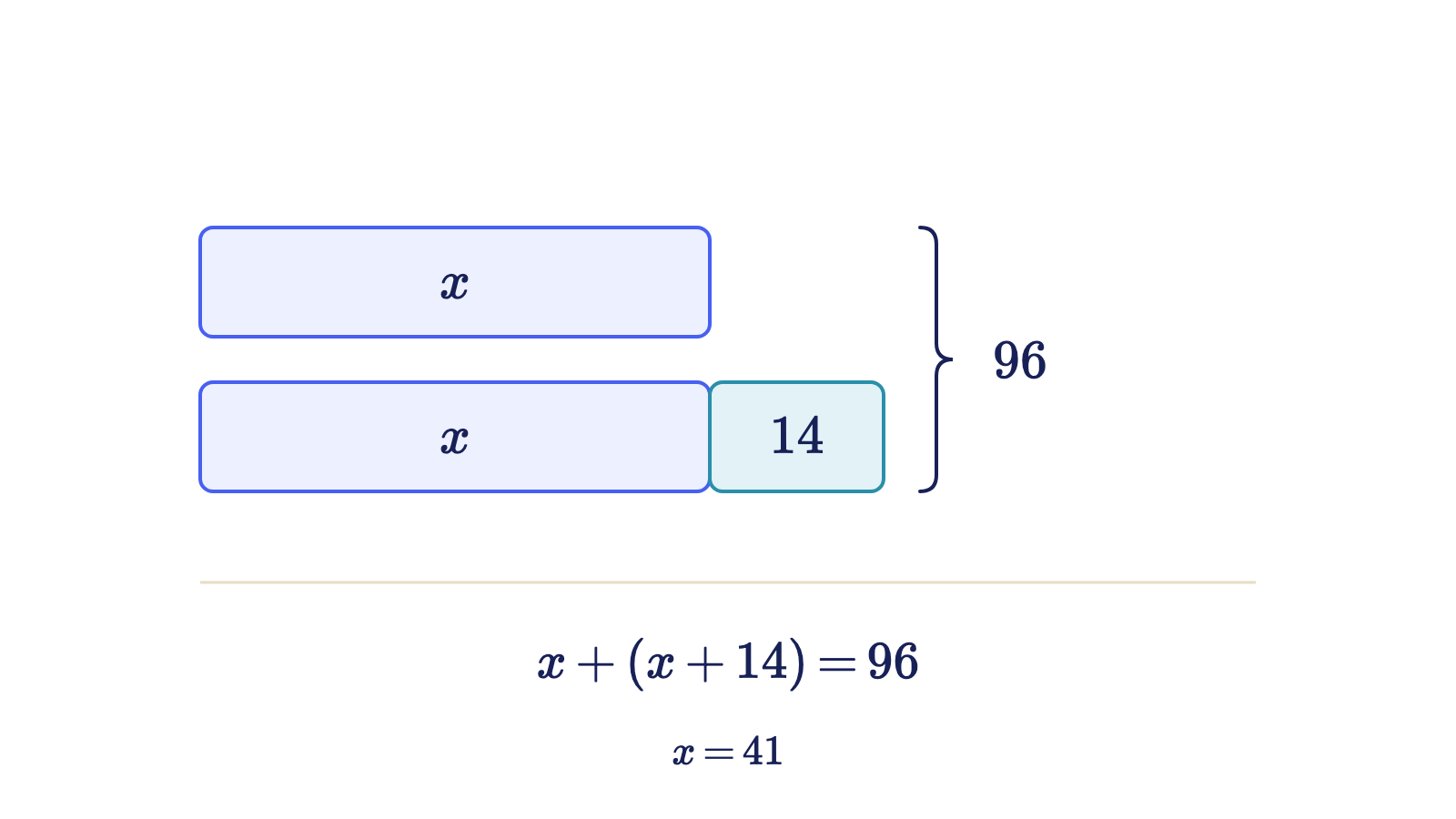
Peter has CZK 14 more than Jana. Together they have CZK 96. How much does Peter have?
- Jana’s money, Peter has x + 14
- together 96
- add
- subtract 14
- divide by 2, that is Jana’s amount
- Answer: Peter has 41 + 14 = CZK 55.
Worked example 2: the price before a discount
After a 20% discount a phone costs CZK 6,400. How much did it cost before?
- the original price
- after a 20% discount 80% of the price is left
- divide by 0.8
- Answer: before the discount the phone cost CZK 8,000.
Check against the problem, not the equation: 80% of CZK 8,000 is CZK 6,400, so it fits. If the mistake were in setting up the equation, substituting into the equation would not reveal it.
Common mistakes in word problem examples
-
Answering a different question
What it looks like. You compute x = 12 (the son's age) and hand in 12 although the problem asks about the father.
How to avoid it. After the calculation, reread the question and work out what is asked for. Writing the answer as a full sentence helps.
-
Mixing up “more by” and “times more”
What it looks like. “80 Kč more” becomes , or “4 times as old” becomes .
How to avoid it. “More by” means add (), “times” means multiply ().
-
Checking against the equation instead of the text
What it looks like. You substitute into an equation you set up wrongly yourself, and everything seems fine.
How to avoid it. Check against the text of the problem: add up the ages, recompute the perimeter, verify the percentage.
FAQ on word problem examples
How do I know what to call x?
Usually the quantity that makes the others easiest to express. In “the father is 4 times as old as the son” it is the son's age; in “the length is 6 cm more than the width” it is the width.
How do I write percentages?
Convert the percentage to a decimal or a fraction: 25 % of a number is , that is .
What if I get a negative or decimal number?
For a number of people or an age it signals an error in the equation: go back to the text. For prices or lengths a decimal can be perfectly fine.
Do word problems appear in entrance exams?
Yes, they are a regular part of the Czech unified entrance exam in maths, and often they are exactly the kind solved with a linear equation.
How does practising on the board work?
Word problems with linear equations can be practised right on Learniva’s interactive board. You write your own working step by step, by hand as on paper or on the keyboard, and Learniva checks every step. If you make a mistake, it marks the step where it happened and tells you what is wrong with it, for example that the step changed the solution of the equation. You can try it for free with any example using the Solve on the board button.
Which school year are these examples for?
The examples on this page are meant for 8th and 9th grade.


Word problems with linear equations follow the Czech RVP ZV, the framework curriculum for basic education issued by the Ministry of Education (MŠMT). Their difficulty matches established Czech lower-secondary problem collections such as F. Běloun’s.
Page created on .