Basic linear equations: worked examples
A basic linear equation is an equation with the unknown in the first power and no fractions that can be rearranged to the form , for example . It is solved by expanding the brackets, moving the x terms to one side and the numbers to the other, and dividing by the number in front of x. Find out more
Every example on linear equations can be solved right on the Learniva board, just like on paper. Learniva checks your whole working and shows you where the mistake is and why.
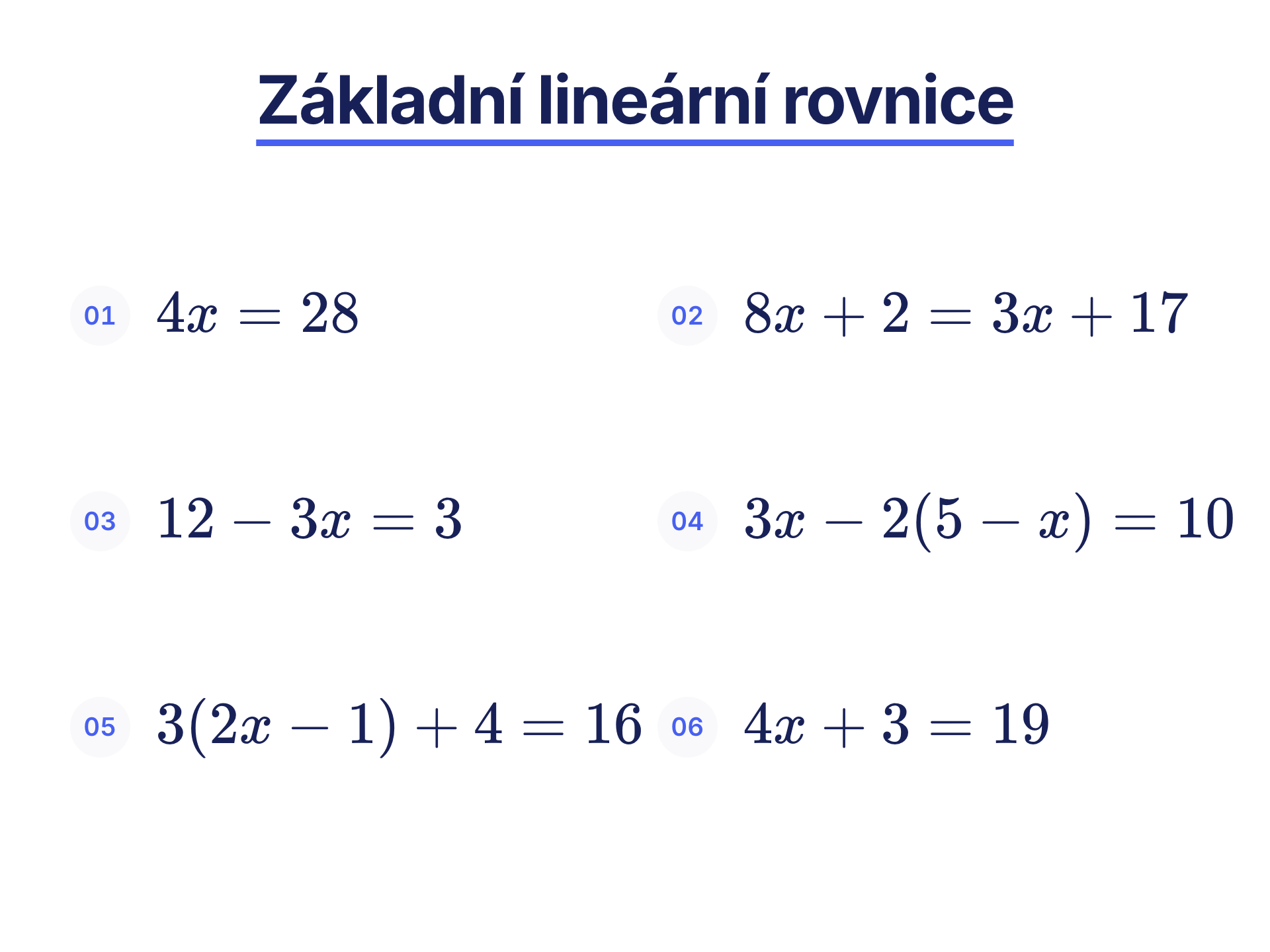
Solve on the board60 basic linear equation examples with solutions and worked steps
Příklady 1–15
-
-
- Move the x terms to the left side:
- Move the numbers to the right side:
- Solve the equation:
Result:
Solve on the board -
- Subtract 12 from both sides:
- Divide the equation by −3.
- Watch the signs (a negative divided by a negative is positive).
Result:
Solve on the board -
-
- Expand the bracket:
- Simplify the left side:
- Subtract 1:
- Divide by 6 and simplify the fraction.
Result:
Solve on the board -
-
-
-
-
-
-
-
-
-
Basic linear equations – examples as a PDF worksheet, free to download
Download the examples from this page as a worksheet in PDF. Just enter your e-mail.
How to solve basic linear equation examples: a step-by-step guide
The balance principle, two worked examples with a note on every line, and the check
What is a basic linear equation?
Every step must keep the equality true. You may add the same expression to both sides or subtract it from both, and multiply or divide both sides by the same non-zero number. That is all you need to solve a basic equation.
Memory aid: the equation as a balance. If you take 3 off the left pan, you must take 3 off the right pan too, or the scale tips. That is why a term changes sign when it moves to the other side: you are really subtracting it from both sides.
How to solve basic linear equation examples
A basic linear equation has one unknown in the first power and can be rearranged into the form . You solve it with equivalent operations: add or subtract the same number on both sides, multiply or divide both sides by the same non-zero number. The equality stays true, it just gets simpler.
Step by step
- Expand the brackets
If the equation has brackets, remove them first. Watch the minus in front of a bracket: it flips every sign inside.
- Move the terms
x terms on one side, numbers on the other. Whatever crosses the equals sign changes its sign.
- Combine and divide
Combine the x terms, combine the numbers and divide both sides by the number in front of x.
- Check the result
Substitute the result into the original equation. If both sides agree, you are done.
The goal is to get every x term on one side and the numbers on the other. In you move 3x to the left and 2 to the right, get and divide by 5. Substituting the result back into the original equation confirms nothing slipped.
Worked example 1: no brackets
- the equation
- subtract 2x from both sides
- add 7 to both sides
- divide both sides by 3
Worked example 2: brackets on both sides
- the equation
- expand both brackets
- add the numbers on each side
- subtract 3x, add 2
- divide by 3
Substitute the result into the original equation, not into a rearranged one. In the second example, x = 3 gives 2 · 10 − 4 = 16 on the left and 3 · 5 + 1 = 16 on the right. The sides are equal, so the answer is correct. If they differ, one of the lines has a mistake, most often a sign.
Common mistakes in basic equation examples
-
Changing the sign of only some terms
What it looks like. Rearranging you write : the 4 crossed the equals sign but kept its sign.
How to avoid it. Every term that crosses the equals sign gets the opposite sign. Here it is .
-
The minus in front of a bracket
What it looks like. gets expanded as .
How to avoid it. A minus in front of a bracket flips the sign of every term inside: .
-
Dividing only one side
What it looks like. From you get because only the left side was divided.
How to avoid it. Every operation applies to both sides. Divide by 5 on the left and on the right: .
FAQ on basic equation examples
What is a basic linear equation?
An equation with one unknown in the first power, without the unknown in a denominator, without absolute value and without a parameter, for example . It has exactly one solution, none, or infinitely many.
In what order should I rearrange an equation?
Brackets, moving terms, combining, dividing, checking. The order is not a law, but it keeps you from mistakes: expand first and nothing gets overlooked.
What if I end up with 0 = 0 or 0 = 5?
means every x satisfies the equation (infinitely many solutions). is never true, so there is no solution. Both are valid results, not calculation errors.
How does practising on the board work?
Basic linear equations can be practised right on Learniva’s interactive board. You write your own working step by step, by hand as on paper or on the keyboard, and Learniva checks every step. If you make a mistake, it marks the step where it happened and tells you what is wrong with it, for example that the step changed the solution of the equation. You can try it for free with any example using the Solve on the board button.
Which school year are these examples for?
The examples on this page are meant for 8th grade.


Basic linear equations follow the Czech RVP ZV, the framework curriculum for basic education issued by the Ministry of Education (MŠMT). Their difficulty matches established Czech lower-secondary problem collections such as F. Běloun’s.
Page created on .