Systems of linear equations: worked examples
A system of linear equations is two equations with two unknowns that must hold at the same time, for example and . It is solved by elimination (the equations are added so that one unknown drops out) or by substitution (one unknown is expressed from one equation and substituted into the other). Find out more
Every example on linear equations can be solved right on the Learniva board, just like on paper. Learniva checks your whole working and shows you where the mistake is and why.
Solve on the board60 examples of systems of equations with solutions and worked steps
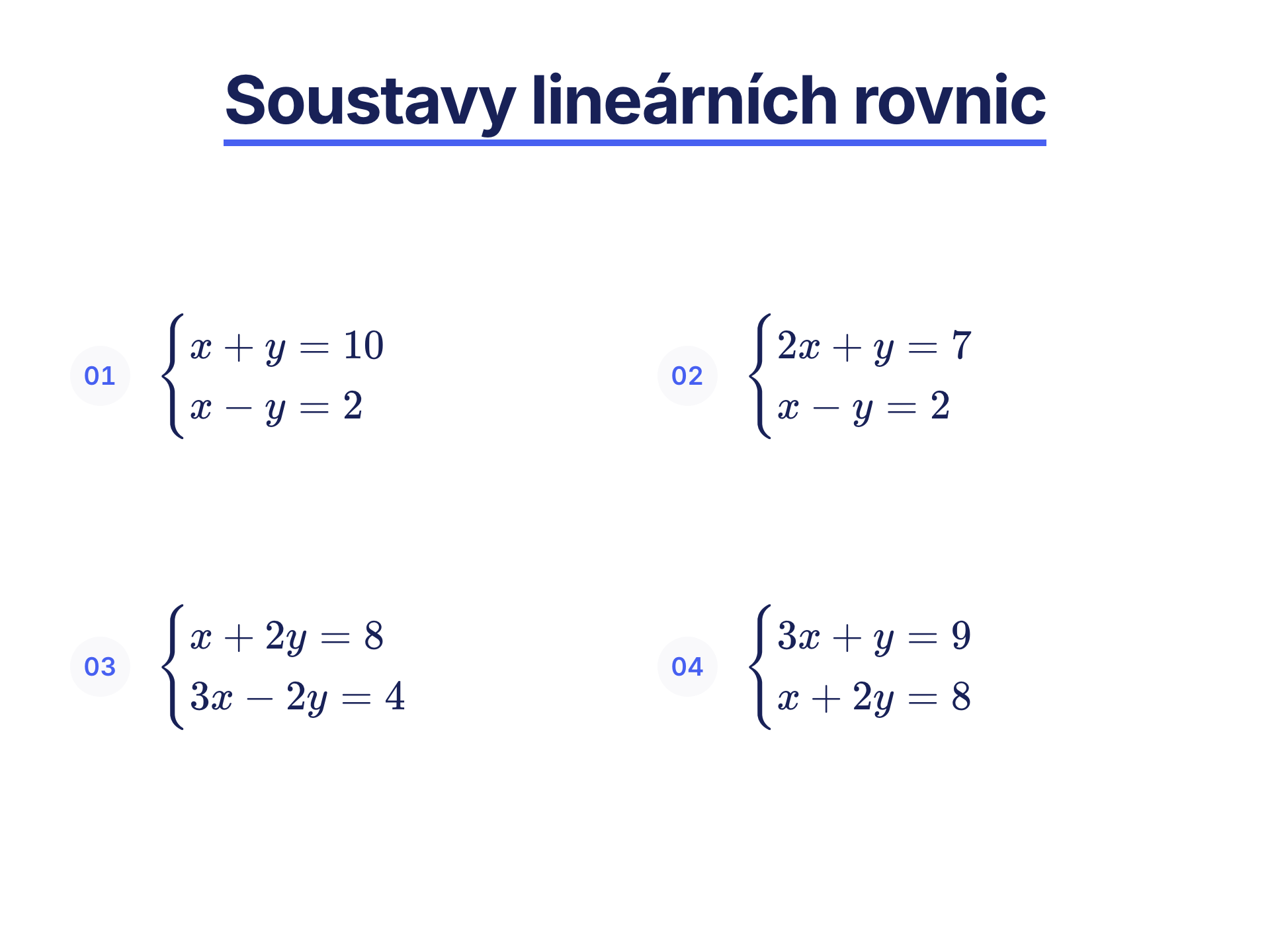
Příklady 1–16
-
-
-
-
- From the first equation, express y:
- Substitute into the second equation:
- Expand:
- Substitute back:
Result:
Solve on the board -
- From the second equation, express x:
- Substitute into the first equation:
- Expand:
- Substitute back:
Result:
Solve on the board -
- Divide the first equation by 2:
- Add the two equations:
- Divide by 3:
- Substitute into the second equation:
Result:
Solve on the board -
-
- Subtract the second equation from the first:
- Divide by 4:
- Substitute into the second equation:
Result:
Solve on the board -
- Substitute x = 2y into the second equation:
- Add up:
- Divide by 3:
- Substitute back:
Result:
Solve on the board -
-
-
- From the second equation, express y:
- Substitute into the first equation:
- Expand:
- Substitute back:
Result:
Solve on the board -
-
- From the second equation, express x:
- Substitute into the first equation:
- Expand:
- Substitute back:
Result:
Solve on the board -
- Multiply the first equation by 2:
- Add the two equations:
- Divide by 12:
- Substitute into the first equation:
Result:
Solve on the board -
Příklady 17–32
-
- Substitute y = 5x into the second equation:
- Add up:
- Divide by 6:
- Substitute back:
Result:
Solve on the board -
-
- From the second equation, express x:
- Substitute into the first equation:
- Expand:
- Substitute back:
Result:
Solve on the board -
-
- Substitute y = 5x into the second equation:
- Add up:
- Divide by 6:
- Substitute back:
Result:
Solve on the board -
-
- From the second equation, express x:
- Substitute into the first equation:
- Expand:
- Substitute back:
Result:
Solve on the board -
-
-
- From the second equation, express x:
- Substitute into the first equation:
- Expand:
- Substitute back:
Result:
Solve on the board -
-
-
- Substitute y = 2x into the second equation:
- Add up:
- Divide by 3:
- Substitute back:
Result:
Solve on the board -
-
- From the second equation, express x:
- Substitute into the first equation:
- Expand:
- Substitute back:
Result:
Solve on the board -
Příklady 33–46
-
- Substitute y = 4x into the second equation:
- Add up:
- Divide by 5:
- Substitute back:
Result:
Solve on the board -
-
- From the second equation, express x:
- Substitute into the first equation:
- Expand:
- Substitute back:
Result:
Solve on the board -
-
- Substitute y = 2x into the second equation:
- Add up:
- Divide by 3:
- Substitute back:
Result:
Solve on the board -
-
-
-
-
- From the second equation, express x:
- Substitute into the first equation:
- Expand:
- Substitute back:
Result:
Solve on the board -
-
- Substitute y = 5x into the second equation:
- Add up:
- Divide by 6:
- Substitute back:
Result:
Solve on the board -
-
- From the second equation, express x:
- Substitute into the first equation:
- Expand:
- Substitute back:
Result:
Solve on the board
Příklady 47–60
-
-
-
- Substitute y = 3x into the second equation:
- Add up:
- Divide by 4:
- Substitute back:
Result:
Solve on the board -
-
- From the second equation, express x:
- Substitute into the first equation:
- Expand:
- Substitute back:
Result:
Solve on the board -
-
-
- From the second equation, express x:
- Substitute into the first equation:
- Expand:
- Substitute back:
Result:
Solve on the board -
-
- Substitute y = 2x into the second equation:
- Add up:
- Divide by 3:
- Substitute back:
Result:
Solve on the board -
-
- From the second equation, express x:
- Substitute into the first equation:
- Expand:
- Substitute back:
Result:
Solve on the board -
-
Systems of linear equations – examples as a PDF worksheet, free to download
Download the examples from this page as a worksheet in PDF. Just enter your e-mail.
How to solve examples of systems of linear equations: a step-by-step guide
Elimination and substitution on worked examples, and the check in both equations
What is a system of linear equations?
The solution of a system is a pair of numbers that works in both equations at once. Both methods do the same thing: they turn two equations in two unknowns into one equation in one unknown.
Memory aid: cancel one unknown. Look for the unknown whose coefficients are equal or opposite in both equations, or easy to make so by multiplying. Adding or subtracting the equations removes it.
How to handle examples with systems of equations
A system of two linear equations in two unknowns usually has one solution: a pair of numbers x and y that satisfies both equations at once. Elimination adds (or subtracts) the equations so that one unknown disappears: for and the sum gives straight away.
Step by step
- Choose a method
If an unknown has opposite coefficients, add the equations. If an unknown stands alone (coefficient 1), express it and substitute.
- Eliminate one unknown
Add the equations, or substitute the expressed unknown into the other equation. One equation in one unknown remains.
- Find the second unknown
Substitute the value you found into either of the original equations.
- Check in both equations
Substitute the pair into both equations. Both must hold; one is not enough.
Substitution expresses one unknown from one equation and substitutes it into the other. It suits systems where an unknown has coefficient 1, such as . Both methods give the same result; pick the one with less arithmetic.
Worked example 1: elimination
- the system, y has opposite coefficients
- add the equations, y cancels out
- divide by 4
- substitute x into the second equation
- work out y
Worked example 2: substitution
- the system, y is already isolated
- substitute for y in the second equation
- add, then add 1
- divide by 5
- work out y from the first equation
Substitute the pair x = 3, y = 5 into both original equations: 2 · 3 − 1 = 5 and 3 · 3 + 5 = 14. Both must hold. If only one does, the solution is wrong.
Common mistakes in examples with systems
-
Checking only one equation
What it looks like. The pair fits the first equation, but you skip the second and a slip in computing y goes unnoticed.
How to avoid it. Always substitute into both original equations. It takes seconds and catches every arithmetic error.
-
Signs when subtracting equations
What it looks like. In you get instead of because the sign of −y was not flipped.
How to avoid it. Treat subtracting an equation as adding it with all signs flipped: .
-
Only part of an equation multiplied
What it looks like. Multiplying by 2 you write .
How to avoid it. Both sides get multiplied: .
FAQ on examples with systems of equations
Which method should I use, elimination or substitution?
Both give the same result. Elimination suits systems where one unknown has equal or opposite coefficients in both equations. Substitution suits systems where an unknown is already expressed or has coefficient 1.
Can a system have more solutions or none?
Yes. If simplifying gives , both equations describe the same line and there are infinitely many solutions. If a false statement like appears, the lines are parallel and there is no solution.
What does the solution mean geometrically?
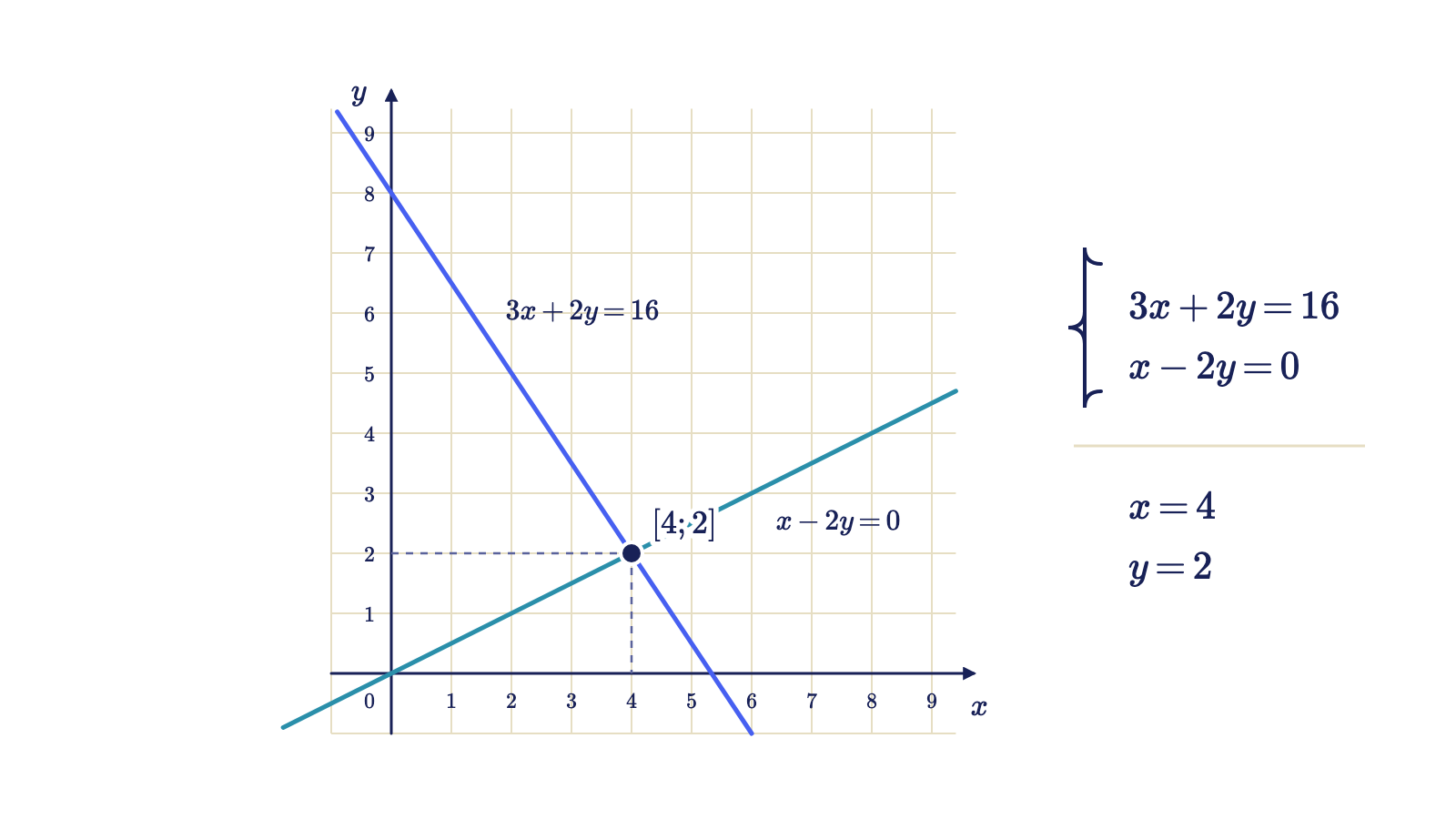
Each equation is a line in the plane. The solution is the point where the lines cross: its coordinates are x and y.
Do systems appear in entrance and school-leaving exams?
In Czech secondary-school entrance exams they appear mostly as word problems with two unknowns. In the school-leaving maths exam, systems of equations are a standard task.
How does practising on the board work?
Systems of linear equations can be practised right on Learniva’s interactive board. You write your own working step by step, by hand as on paper or on the keyboard, and Learniva checks every step. If you make a mistake, it marks the step where it happened and tells you what is wrong with it, for example that the step changed the solution of the equation. You can try it for free with any example using the Solve on the board button.
Which school year are these examples for?
The examples on this page are meant for 9th grade.


Systems of linear equations follow the Czech RVP ZV, the framework curriculum for basic education issued by the Ministry of Education (MŠMT). Their difficulty matches established Czech lower-secondary problem collections such as F. Běloun’s.
Page created on .