Linear equations with absolute value: worked examples
A linear equation with absolute value is an equation with the unknown inside an absolute value, in its simplest form , for example . It is solved by splitting into two cases according to the sign of the expression inside the absolute value, so it usually has two solutions, here and . Find out more
Every example on linear equations can be solved right on the Learniva board, just like on paper. Learniva checks your whole working and shows you where the mistake is and why.
Solve on the board60 absolute value equation examples: solutions and worked steps
Equations with absolute value – examples as a PDF worksheet, free to download
Download the examples from this page as a worksheet in PDF. Just enter your e-mail.
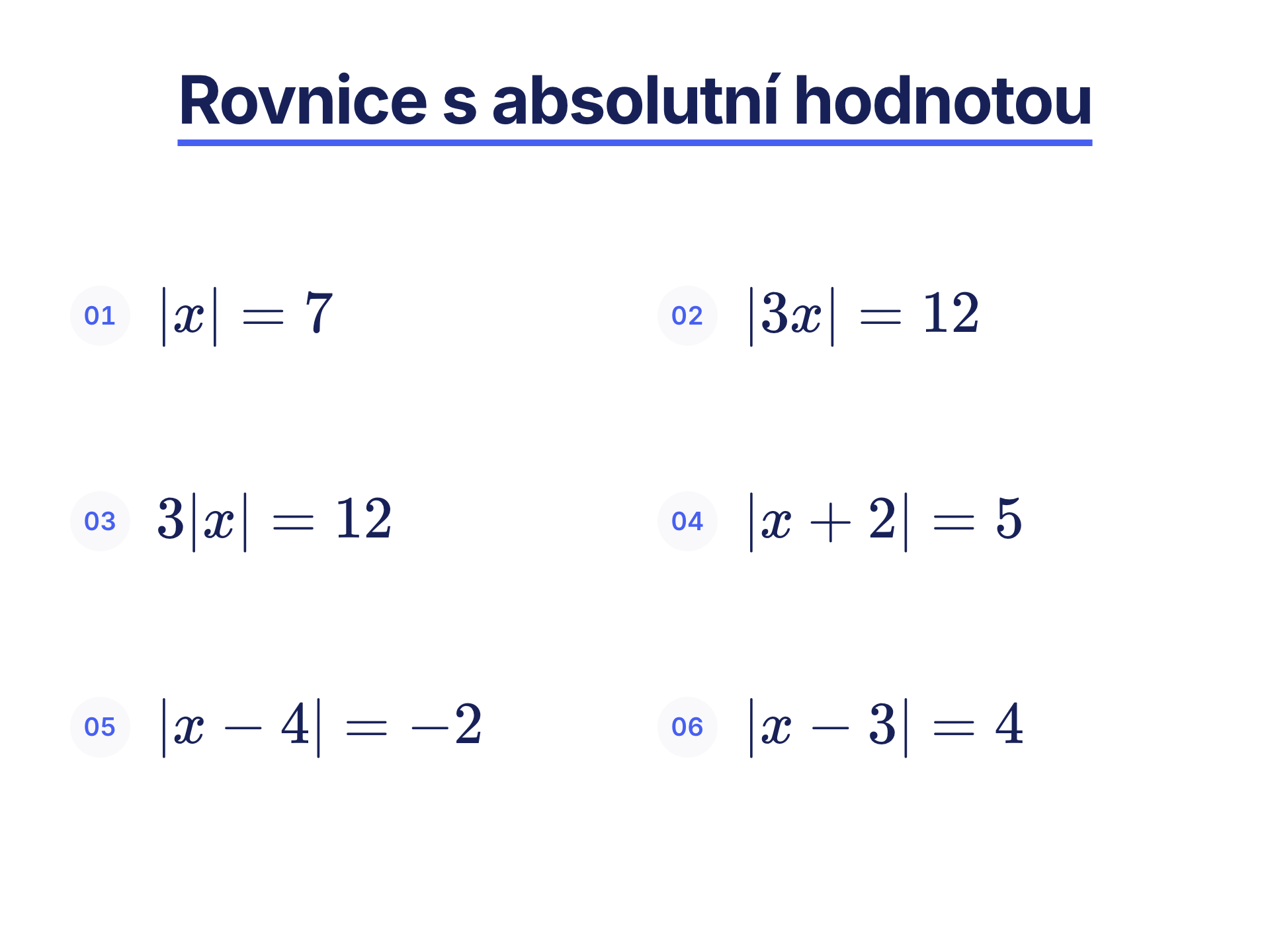
How to solve examples of absolute value equations: a step-by-step guide
Why there are two cases, two worked examples and when there is no solution
What is an equation with absolute value?
The absolute value of a number is its distance from zero on the number line, so it is never negative. The equation |expression| = 4 says the expression is 4 away from zero, which is true for both 4 and −4.
The two-case rule: first isolate the absolute value on one side. If the other side is positive you get two cases, if it is zero just one, and if it is negative the equation has no solution.
How to handle absolute value examples
is satisfied by two numbers, 7 and −7, because both are 7 away from zero. The same goes for an expression inside the bars: means or . Solve each case separately and write down both results.
Step by step
- Isolate the absolute value
Move the numbers around it to the other side or divide: turn into .
- Check the right side
Negative: no solution. Zero: one case. Positive: two cases.
- Split into two cases
The expression inside equals the right side or its opposite. Solve both cases as linear equations.
- Write down and check both solutions
Substitute each one separately into the original equation.
Two special cases: an absolute value cannot be negative, so has no solution, and it equals zero at exactly one point, so has the single solution x = 6. If there is anything around the bars (), isolate the absolute value first.
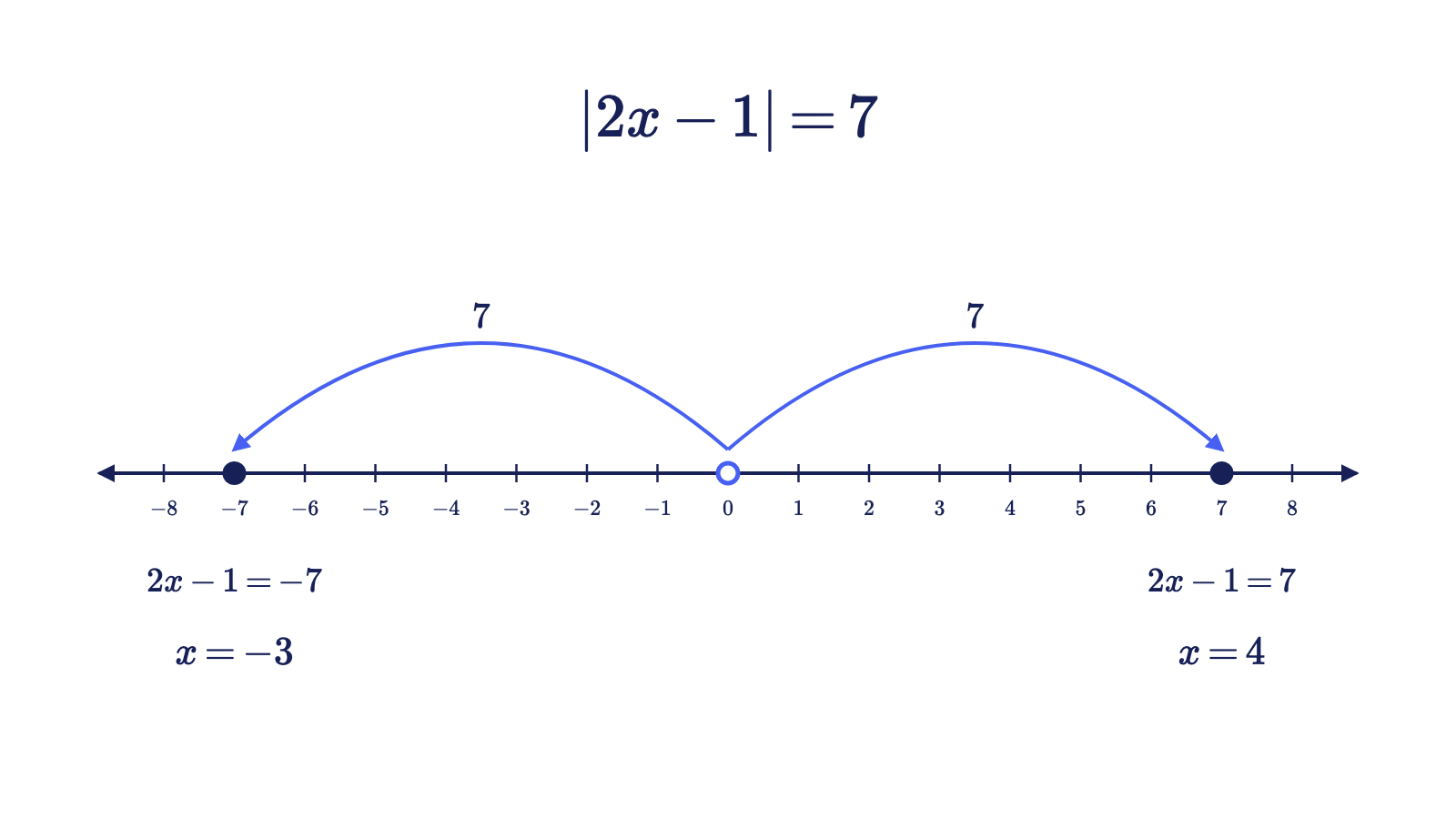
Worked example 1: two cases
- the equation, the right side is positive
- first case
- add 1 and divide by 2
- second case
- add 1 and divide by 2
Worked example 2: isolate first
- the equation
- add 5
- divide by 3
- first case
- subtract 2
- second case
- subtract 2
Substitute both solutions into the original. For x = 2, 3 · |4| − 5 = 7, and for x = −6, 3 · |−4| − 5 = 7. Both hold, so the equation has two solutions.
Common mistakes in absolute value examples
-
The forgotten second case
What it looks like. From you only get x = 7.
How to avoid it. Always solve as well, giving x = −1. Write the two cases one under the other so neither gets lost.
-
Solving a negative right side
What it looks like. For you write and x = 2.
How to avoid it. Look at the right side first. A negative number means there is no solution and the calculation stops there.
-
Splitting before isolating
What it looks like. You split into and .
How to avoid it. Subtract 3 first: , and only then split into x = 7 and x = −7.
FAQ on absolute value examples
What is absolute value?
The distance of a number from zero on the number line. It is never negative: and .
Why does an absolute value equation have two solutions?
Because two different numbers, one positive and one negative, are the same distance from zero. So the expression inside can equal the right side or its opposite.
When is there only one solution, or none?
One when the absolute value equals zero. None when it is supposed to equal a negative number.
How are equations with two absolute values solved?
By splitting the number line into intervals at the zeros of both expressions and solving on each interval separately. Those are upper-secondary-level problems and are not in this list.
How does practising on the board work?
Equations with absolute value can be practised right on Learniva’s interactive board. You write your own working step by step, by hand as on paper or on the keyboard, and Learniva checks every step. If you make a mistake, it marks the step where it happened and tells you what is wrong with it, for example that the step changed the solution of the equation. You can try it for free with any example using the Solve on the board button.
Which school year are these examples for?
The examples on this page are meant for the 1st year of upper secondary school.


Equations with absolute value follow the Czech upper-secondary mathematics curriculum (framework programmes of the Ministry of Education, MŠMT, RVP) and their difficulty matches established upper-secondary problem collections.
Page created on .