Linear equations from entrance exams: worked examples
Linear equations in entrance exams for upper secondary schools are equations that combine fractions, decimals and brackets in one task, for example . They are solved by first removing the fractions and decimals through multiplication and then continuing as with a basic equation. Find out more
Every example on linear equations can be solved right on the Learniva board, just like on paper. Learniva checks your whole working and shows you where the mistake is and why.
Solve on the board60 entrance-exam equation examples with solutions and worked steps
The tasks match the types used in the CERMAT unified entrance exams 2023–2026.
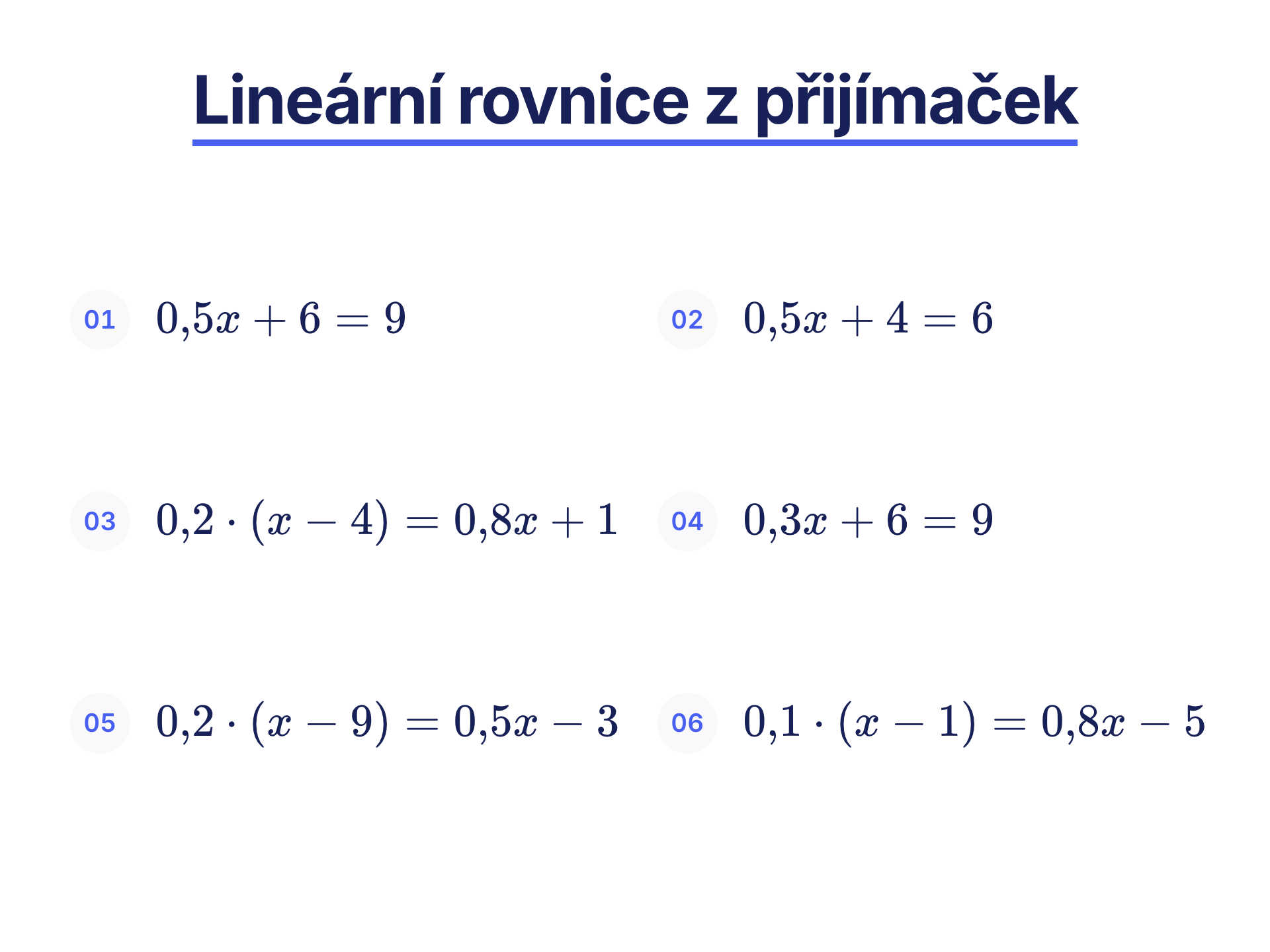
Příklady 1–16
-
- Expand the brackets:
- Add up the whole numbers:
- Multiply the whole equation by 10:
- Simplify:
- Move x to one side:
Result:
Solve on the board -
- Simplify the fraction on the right:
- Multiply the whole equation by 6:
- Expand:
- Simplify:
- Rearrange:
Result:
Solve on the board -
- Write 3.5x as a fraction:
- Multiply the whole equation by 6:
- Simplify:
- Rearrange:
Result:
Solve on the board -
- Multiply the whole equation by 8:
- Expand (watch the minus):
- Simplify both sides:
- Rearrange:
Result:
Solve on the board -
-
- Simplify the left side:
- Simplify the fraction on the right:
- Multiply the whole equation by 6:
- Expand:
- Rearrange:
Result:
Solve on the board -
- Expand the brackets:
- Multiply the whole equation by 8:
- Combine the x terms:
- Rearrange:
Result:
Solve on the board -
-
-
-
- Expand the brackets:
- Combine the x terms on the left:
- Subtract 3.5x from both sides:
- This is false, so the equation has no solution.
Result: No solution
Solve on the board -
- Multiply the whole equation by 12:
- Expand:
- Combine like terms:
- Rearrange:
Result:
Solve on the board -
-
-
-
Příklady 17–32
-
- Multiply the whole equation by 12:
- Watch the minus in front of the bracket:
- Simplify:
- Rearrange:
Result:
Solve on the board -
-
- Expand the brackets:
- Combine the x terms on the left:
- Subtract 3{,}5x from both sides:
- This is false, so the equation has no solution.
Result: No solution
Solve on the board -
- Multiply the whole equation by 12:
- Watch the minus in front of the bracket:
- Simplify:
- Rearrange:
Result:
Solve on the board -
-
- Expand the brackets:
- Combine the x terms on the left:
- Subtract 2{,}5x from both sides:
- This is false, so the equation has no solution.
Result: No solution
Solve on the board -
-
- Multiply the whole equation by 12:
- Watch the minus in front of the bracket:
- Simplify:
- Rearrange:
Result:
Solve on the board -
-
- Expand the brackets:
- Combine the x terms on the left:
- Subtract 3{,}5x from both sides:
- This is false, so the equation has no solution.
Result: No solution
Solve on the board -
- Multiply the whole equation by 12:
- Watch the minus in front of the bracket:
- Simplify:
- Rearrange:
Result:
Solve on the board -
-
- Expand the brackets:
- Combine the x terms on the left:
- Subtract 4{,}5x from both sides:
- This is false, so the equation has no solution.
Result: No solution
Solve on the board
Příklady 33–46
-
-
- Multiply the whole equation by 12:
- Watch the minus in front of the bracket:
- Simplify:
- Rearrange:
Result:
Solve on the board -
-
- Multiply the whole equation by 12:
- Watch the minus in front of the bracket:
- Simplify:
- Rearrange:
Result:
Solve on the board -
-
- Expand the brackets:
- Combine the x terms on the left:
- Subtract 3{,}5x from both sides:
- This is false, so the equation has no solution.
Result: No solution
Solve on the board -
-
- Multiply the whole equation by 6:
- Watch the minus in front of the bracket:
- Simplify:
- Rearrange:
Result:
Solve on the board -
-
- Expand the brackets:
- Combine the x terms on the left:
- Subtract 2{,}5x from both sides:
- This is false, so the equation has no solution.
Result: No solution
Solve on the board -
-
- Multiply the whole equation by 6:
- Watch the minus in front of the bracket:
- Simplify:
- Rearrange:
Result:
Solve on the board -
-
- Expand the brackets:
- Combine the x terms on the left:
- Subtract 4{,}5x from both sides:
- This is false, so the equation has no solution.
Result: No solution
Solve on the board
Příklady 47–60
-
- Multiply the whole equation by 6:
- Watch the minus in front of the bracket:
- Simplify:
- Rearrange:
Result:
Solve on the board -
-
- Expand the brackets:
- Combine the x terms on the left:
- Subtract 2{,}5x from both sides:
- This is false, so the equation has no solution.
Result: No solution
Solve on the board -
- Multiply the whole equation by 6:
- Watch the minus in front of the bracket:
- Simplify:
- Rearrange:
Result:
Solve on the board -
-
- Expand the brackets:
- Combine the x terms on the left:
- Subtract 4{,}5x from both sides:
- This is false, so the equation has no solution.
Result: No solution
Solve on the board -
-
- Multiply the whole equation by 12:
- Watch the minus in front of the bracket:
- Simplify:
- Rearrange:
Result:
Solve on the board -
-
- Expand the brackets:
- Combine the x terms on the left:
- Subtract 2{,}5x from both sides:
- This is false, so the equation has no solution.
Result: No solution
Solve on the board
Linear equations from entrance exams – examples as a PDF worksheet, free to download
Download the examples from this page as a worksheet in PDF. Just enter your e-mail.
How to solve entrance exam equation examples: a step-by-step guide
Decimals, fractions and brackets in one equation, on two worked examples
What do the entrance-exam equations look like?
Entrance exam equations combine several things at once. The fastest way is to turn them into a basic equation in a fixed order: decimals, fractions, brackets, moving terms and dividing.
Test tip: remove decimals by multiplying the whole equation by 10 or 100. If there are fractions too, pick a number that handles both at once, for example 10 for denominators 2 and 5.
How to handle entrance-exam examples
The Czech unified entrance exam in maths (Cermat) regularly includes a linear equation to solve, typically with fractions or decimals and with brackets. The correct result is marked and, in open tasks, the working too. The time limit is tight, so an automatic routine pays off.
Step by step
- Get rid of the decimals
Multiply the whole equation by 10 or 100, or convert the numbers to fractions.
- Common denominator
Multiply the whole equation by the common denominator and put the numerator expressions in brackets.
- Expand and rearrange
Expand the brackets (watch the minus in front), unknowns to one side.
- Check
Substitute into the original equation. In the exam a quick sanity check of the result is worth it too.
A proven routine: convert decimals to fractions or multiply the whole equation by 10, find the common denominator, clear the fractions, expand the brackets and only then move terms. The examples below follow the structure of past exam tasks; the equations themselves are our own, not copied from the tests.
Worked example 1: decimals and a bracket
- the equation
- multiply the whole equation by 10
- expand
- subtract 2x, add 15
- divide by 3
Worked example 2: fractions and a decimal
- the equation
- multiply by 10, which removes both the fractions and the decimal
- expand and add
- subtract 2x, add 5
- divide by 7
Substitute x = 3 into the second example: (3 − 1)/2 + 0.4 · 3 = 1 + 1.2 = 2.2 and (3 + 8)/5 = 2.2. A check in the margin takes a moment and catches an overlooked sign.
Common mistakes in entrance-exam examples
-
Multiplying only some terms
What it looks like. After multiplying by 6 the term without a fraction stays the same: becomes .
How to avoid it. Every term gets multiplied, whole numbers and fraction-free terms included: .
-
A misplaced decimal point
What it looks like. Multiplying by 10, becomes instead of .
How to avoid it. Multiply every term by the same number and check the decimal shift term by term. With hundredths, multiply by 100.
-
Treating “no solution” as a mistake
What it looks like. You get , so you hunt for an error and rewrite a correct calculation.
How to avoid it. A false statement is a legitimate result: the equation has no solution. Write that down and move on.
FAQ on entrance-exam examples
Are linear equations part of the unified entrance exam?
Yes, solving a linear equation is one of the regularly included tasks in the maths test for both four-year and multi-year programmes.
Do I have to show my working in the exam?
In open tasks yes, the working is marked too. Your steps must be legible and complete, including conditions where they belong.
Are these examples taken from actual Cermat tests?
No. They follow the structure and difficulty of past tasks, but the equations are our own.
How do I prepare for exam equations?
Practise regularly and against the clock. In Learniva you can solve each of these examples on the board and get feedback on every step, not just the result.
How does practising on the board work?
Linear equations from entrance exams can be practised right on Learniva’s interactive board. You write your own working step by step, by hand as on paper or on the keyboard, and Learniva checks every step. If you make a mistake, it marks the step where it happened and tells you what is wrong with it, for example that the step changed the solution of the equation. You can try it for free with any example using the Solve on the board button.
Which school year are these examples for?
The examples on this page are meant for 9th grade.


Linear equations from entrance exams follow the Czech RVP ZV, the framework curriculum for basic education issued by the Ministry of Education (MŠMT). Their difficulty matches established Czech lower-secondary problem collections such as F. Běloun’s.
Page created on .